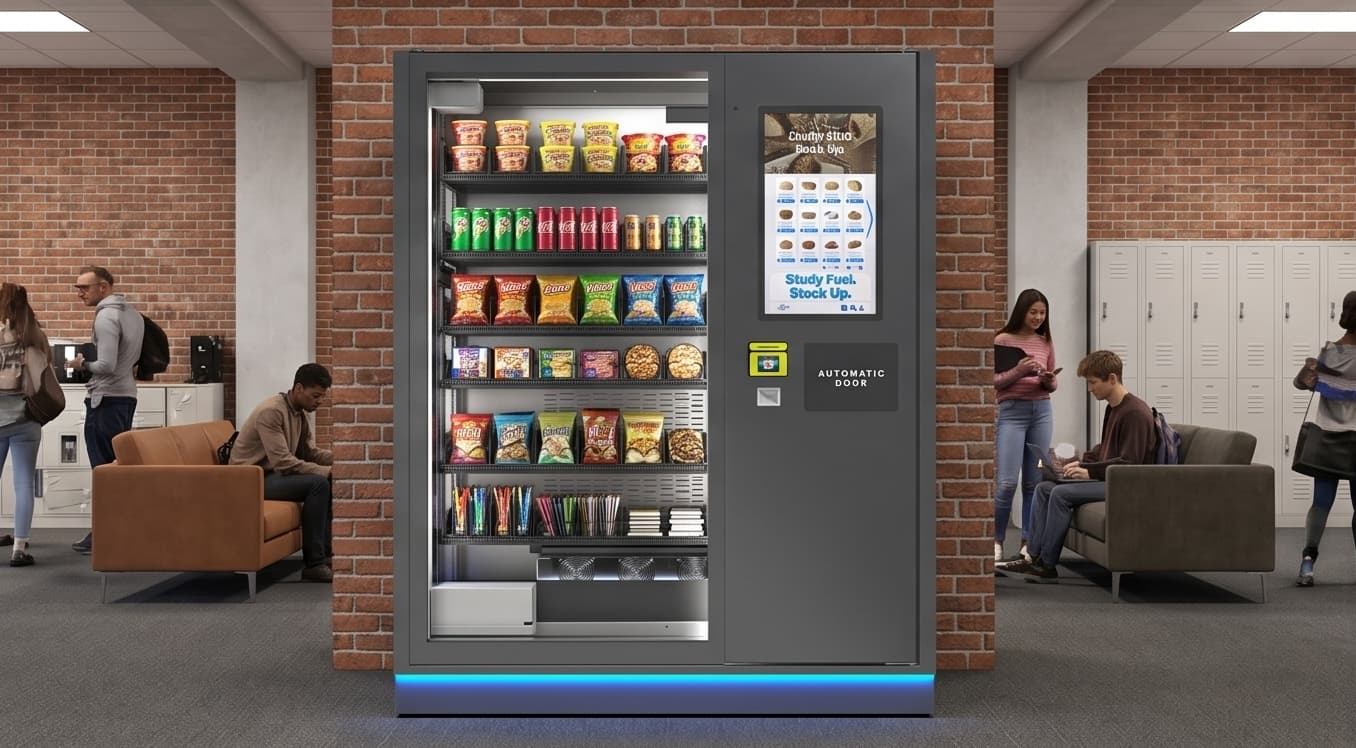
Book Vending Machines for Schools: Harper Elementary, Inchy’s Bookworm, and What an Operator Has to Get Right
A book vending machine for schools is a custom-configured cabinet that dispenses paperbacks, hardbacks, supplies, or learning kits in exchange for tokens, vouchers, staff-issued credits, or student ID taps. The cabinet still uses commercial vending DNA, but the tray geometry, payment flow, supervision model, and refill logic are tuned to an educational corridor rather than to snack-and-drink retail. This page focuses on the worked examples and the operating questions schools and campuses need to answer before a cabinet ships.
For the broader programme-design framework behind education vending, the right companion page is custom vending machines for education: programme design. This page owns the case studies and the day-to-day operating reality.
Harper Elementary and the reading-reward model
Harper Elementary’s use of a book vending machine works because the cabinet is not the programme by itself. It is the visible redemption point at the end of a reading-achievement loop. Students hit a milestone, earn a token, and redeem it publicly in the hallway for a book they choose. That public moment matters. A cabinet in a corridor can turn a quiet academic milestone into a visible ritual, which is often the real behaviour driver.
The hardware is not magical. The operating idea is. When the programme is tied to a real reading goal and staff know how tokens are earned, distributed, and redeemed, the machine reinforces the school culture rather than simply sitting there looking pleased with itself.
Inchy’s Bookworm and the school book-vending category
Inchy’s Bookworm is one of the most cited book-vending formats in U.S. K-12 deployments because it is engineered for book geometry rather than chip-bag geometry. Wider trays, shallower coils, and token-style redemption make it more suitable for paperbacks and children’s hardbacks than a repurposed snack cabinet would be. That matters because a cabinet designed for books usually runs with fewer jams, faster staff restock, and a more child-friendly retrieval experience.
The important takeaway is that “book vending machine” is a category, not a single product. A custom cabinet can be configured for books, but unit economics improve when the machine was specified for that format from the start rather than awkwardly persuaded into it later.
University tech-supply vending is the campus version of the same idea
Universities use custom vending cabinets as a 24/7 extension of the campus bookstore or supply counter. Typical assortment includes USB drives, scantrons, blue books, chargers, cables, calculators, and basic lab consumables. The reason is straightforward: the bookstore closes, the library or engineering building does not, and a student still discovers they need a cable at an antisocial hour.
Payment often runs on student ID or campus-card credit rather than open consumer cash handling, which keeps the workflow inside the existing campus systems. Operationally, this is one of the cleanest education-adjacent vending use cases because the need is obvious, the products are compact, and the cabinet is solving a genuine schedule gap rather than inventing one.
School-supply vending is often the easiest first deployment
If a district wants to pilot education vending without starting with a full literacy-reward programme, a school-supply cabinet is usually the simplest place to begin. Pencils, erasers, scantrons, USB drives, calculators, art basics, and similar items solve one of the most common classroom problems: someone is missing something essential and class time gets wasted while an adult improvises a rescue.
That makes the cabinet easier to justify operationally. It can run on student ID, staff-issued credits, or a modest cashless flow, restocks more predictably than food vending, and avoids the nutrition-policy headaches that come with edible products on campus.
Operations questions every school or campus has to answer
Every education vending deployment eventually lands on the same practical questions. Who restocks the cabinet and how often? Who supervises it during access hours? How are tokens, vouchers, or credits earned and audited? Where is the cabinet sited relative to staff sightlines? What happens when the original programme owner leaves, the grant runs out, or the initiative changes direction?
Those questions are not boring admin trivia. They are the difference between a cabinet that keeps serving students and one that becomes hallway décor with electrical draw.
What to ask for on the spec sheet
For a book or school-supply cabinet, the spec should match the products rather than defaulting to snack assumptions. Ask for tray geometry that fits the largest expected SKU, a front-load door that staff can restock without theatre, a closed-loop or ID-compatible reader using standard communications such as MDB/ICP, and reporting that surfaces usage in software rather than forcing staff to keep a clipboard census. If the programme needs weekly audit visibility, DEX-style reporting or an equivalent modern reporting path should be specified up front.
None of that is exotic. It just has to be written down, because the default vending spec sheet was not built with books and school supplies in mind.
Need an education vending deployment that works after the ribbon-cutting?
DMVI can help you scope the cabinet, redemption flow, stock model, and supervision plan so the machine supports the programme instead of becoming a well-lit hallway ornament.