Custom Vending Machines for Education: Designing a Programme That Earns Its Place in the Hallway
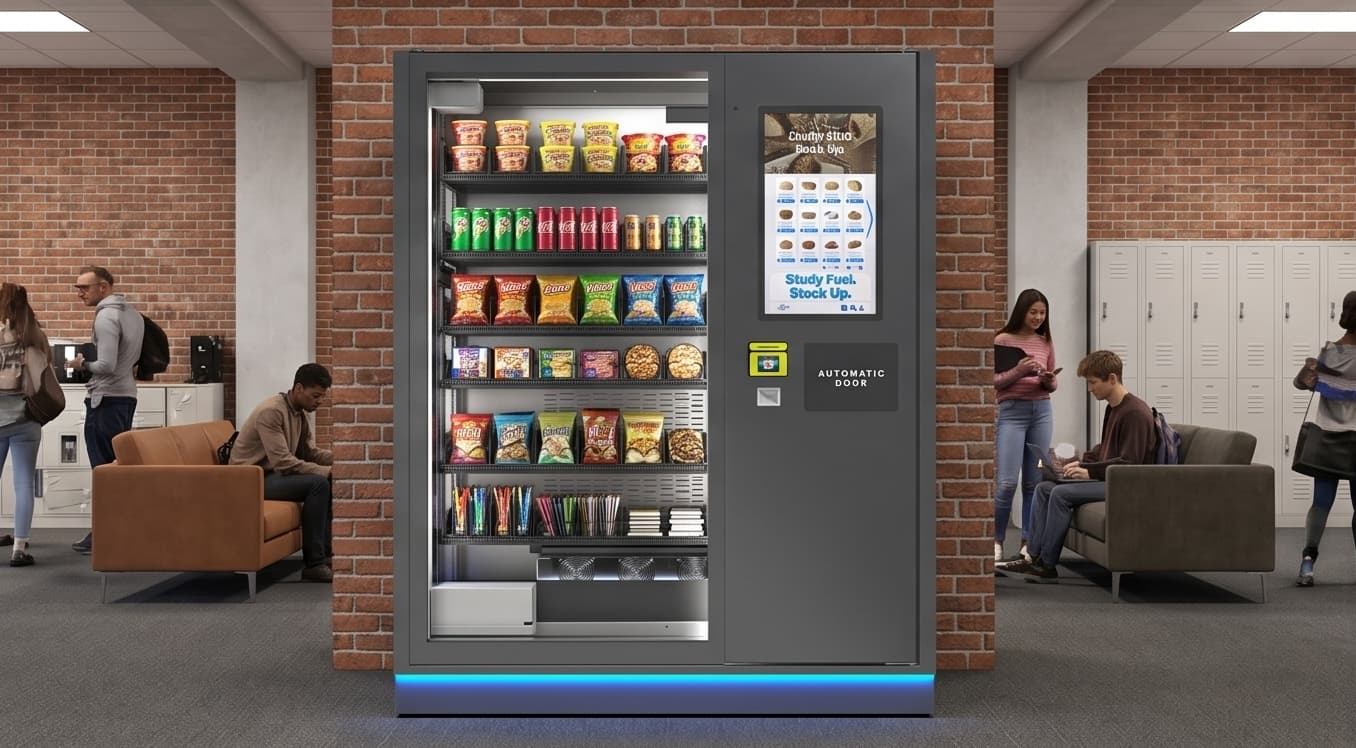
A custom vending machine for education is a purpose-built cabinet whose branding, assortment, dispense logic, and payment method are configured around a specific school or district programme rather than around ordinary retail snack sales. That programme might be literacy reward, behaviour incentive, supplies access, fundraising, wellness distribution, or dorm convenience. The hardware is still commercial-grade vending. What makes it educational is the programme wrapper around it and whether that wrapper is strong enough to survive past the novelty phase.
This page is about programme design rather than case-study storytelling. If the question is how a specific school deployment works in practice, that belongs on the companion education example page rather than being muddled into the planning brief.
What kinds of education programmes a custom cabinet can actually support
Not every school vending project is trying to do the same job, which is why lazy “book machine for schools” copy misses the point. The recurring programme types are behaviour and literacy reward, cashless supplies access, fundraising and spirit-store retail, wellness and hygiene distribution, and dorm or residence-hall convenience. Each of those asks for a different assortment, different dispense logic, and a different success metric.
A literacy programme may need closed-loop token redemption for books or learning materials. A supplies access cabinet may need student ID or staff-issued credits for calculators, pencils, scantrons, or lab consumables. A spirit-store cabinet may use ordinary parent or student payment but still need a branded wrap and simpler volunteer oversight. The programme defines the cabinet, not the other way round.
How education payment logic differs from retail vending
A normal commercial vending machine takes cash or card and dispenses against payment. Many education programmes do not. They run on tokens, teacher-issued credits, student ID taps, account balances, or free-vend unlocks tied to a school rule. That changes the conversation completely. The buyer is no longer just a vending operator chasing revenue per slot; it is a principal, district administrator, or programme owner trying to support a specific educational objective.
On the hardware side, that often means a closed-loop reader or custom rule set riding the same cabinet platform a commercial machine would use, including standard controller and reader communications such as MDB/ICP. The mechanism is commercial. The logic sitting above it is institutional.
What has to be owned before the cabinet ships
School vending programmes tend to fail for boring reasons rather than technological ones. A cabinet arrives, everyone admires it for a fortnight, and then nobody quite owns stock, rules, supervision, or replenishment. Before procurement closes, five owners should be named in writing: an executive sponsor tied to the written goal, a restock owner with budget and cadence, a redemption-rule owner, a supervision owner during student access, and an end-of-life owner with authority to retire or repurpose the cabinet if the programme fizzles.
Without those five names, the machine risks becoming an expensive hallway ornament. Schools have enough of those already.
What is actually customised in an education vending deployment
Customisation is usually less about wizardry and more about making the machine fit the programme honestly. That can include the wrap and branding, coil pitch and tray depth for the chosen products, dispense logic, planogram and low-stock reporting, and access or telemetry rules that match the school’s workflow. A district may want mascot branding and literacy messaging visible from the corridor. A supplies cabinet may care more about inventory alerts and easy front-load restock than about visual theatre.
Reporting should also match the programme. A school leader often needs redemption counts by cohort or term, not merely a retail-style sales summary. Modern audit tooling such as DEX-style reporting can still matter, but the interpretation of the data changes because the programme objective is different.
How to know whether the programme is working
Revenue is usually the wrong scoreboard for an education vending programme. A literacy cabinet is working when more students hit the reading target. A supplies access cabinet is working when teachers lose less class time to missing basics. A behaviour programme cabinet is working when redemption supports the behaviour goal rather than simply emptying the machine faster.
The metric should be defined before procurement, reviewed every term, and treated honestly. If the objective is not moving, the programme needs revision or retirement. Redemption against purpose matters more than raw SKU velocity.
Where to go next
If the reader needs a worked example of how these design choices play out in a real education deployment, the next stop should be custom vending machines in education: a worked example. If the reader is still deciding between smart, digital, and custom cabinet architectures more broadly, the useful comparison page is high-tech vending machines for sale.
Planning an education vending programme that survives beyond launch week?
DMVI can help you design the cabinet, payment logic, ownership model, and reporting around the actual school objective instead of shipping a machine and hoping enthusiasm does the rest.