Smart Vending Machine Security: Physical, Network, and Payment Data Protection
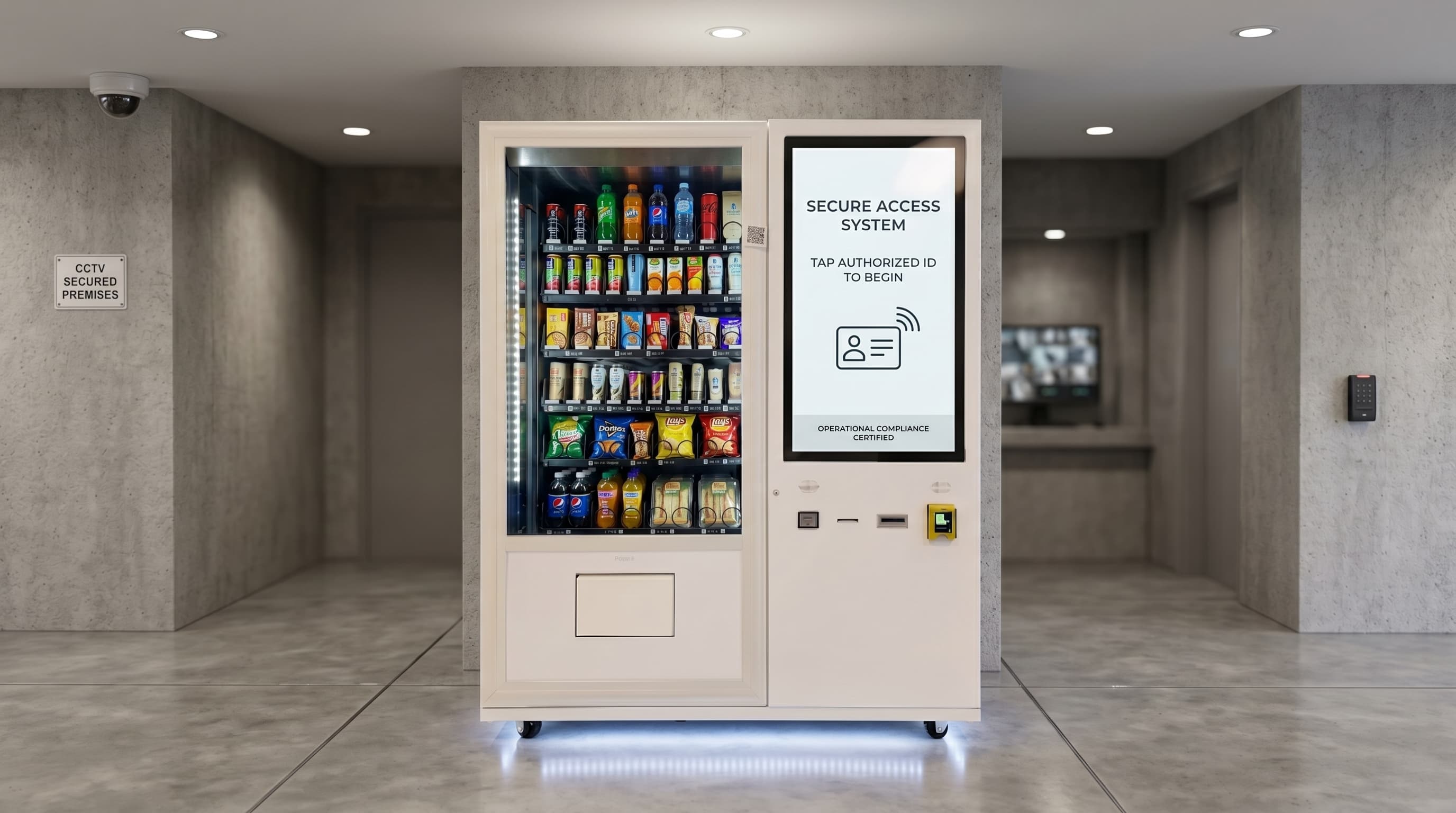
Smart vending machine security is not a single lock, setting, or compliance badge. It is the operating discipline of protecting a connected vending cabinet across three surfaces at once: the physical machine, the network and software that support it, and the payment environment that processes customer transactions. A traditional cash-only machine mostly invited forced entry. A cloud-connected cabinet with telemetry, touchscreens, and cashless payments inherits a broader and more interesting collection of problems.
That does not make connected vending reckless. It simply means the operator needs an actual security plan rather than a hopeful shrug and a spare key.
Physical security starts with the cabinet and the site
Physical risk is still the most visible threat on most routes. Forced entry, vandalism, tampering, and payment-terminal interference remain very ordinary ways for money to disappear. Cabinet construction matters, but placement matters just as much. A machine in a supervised lobby with strong sightlines lives a different life than one tucked into a dim corridor where everybody can loiter and nobody can remember having seen a thing.
Anchoring, lighting, visibility, and the quality of the locking hardware should all be treated as part of the machine specification rather than as afterthoughts once the cabinet is already on site.
Key control is one of the most boring and most common failures
Operators often spend time thinking about advanced threats while ignoring the very unglamorous issue of key control. If a route uses widely copied keys, casual duplication can quietly turn an entire fleet into an open secret. Restricted-keyway or stronger access control options are often far more useful than people expect, especially on higher-risk routes or mixed-staff operations.
Boring failures are still failures. They are simply less photogenic.
Payment-terminal tampering needs routine inspection
Cashless vending reduces on-machine cash risk, but the payment hardware becomes a more attractive target. Operators should inspect card readers and surrounding bezels during service visits for signs of skimmers, overlays, forced opening, or other physical tampering. Some terminals support tamper alerts, but even when they do, a human visual check still matters.
If a payment device looks wrong, the sensible response is to stop treating it as trustworthy until proven otherwise.
Network and software security are now part of route discipline
A smart vending machine is also a connected device. It reports sales and machine health, may receive remote pricing or content changes, and relies on credentialed access to management tools. That means weak passwords, stale firmware, sloppy offboarding, and careless connectivity choices can all become security problems rather than mere administrative untidiness.
Operators should prefer clean, controlled connectivity, keep firmware and software current, remove access promptly when staff change, and use per-user credentials and multi-factor authentication where the platform supports them. A shared password passed around like office biscuits is not a security policy.
Payment security and PCI scope still belong to the operator
The payment terminal provider and platform vendor may handle important pieces of the stack, but that does not magically remove operator responsibility. If the machine accepts card payments, PCI considerations are part of the operating picture. The safest practical pattern is to use reputable, certified payment hardware so card data stays inside the proper payment environment rather than leaking into machine logs, dashboards, or improvised integrations where it has no business living.
The guiding principle is mercifully simple: do not store or expose raw card data, and do not assume somebody else is covering your side of the fence unless that responsibility is actually clear.
Incident response should be decided before the incident
If a machine appears to have been tampered with, the operator should already know the first steps: take the machine out of payment service if needed, document what was seen, notify the relevant payment or hardware providers, and avoid casually putting the machine back into service because everyone is busy and it will probably be fine. “Probably” is not much of a control framework.
Good security is not just prevention. It is also the speed and clarity of the response when prevention fails.
Security is part of commercial reliability
Some operators treat security as an unpleasant compliance appendix. It is more useful to treat it as part of uptime and commercial reliability. A machine that is vandalised, skimmed, misconfigured, or left with loose access control is not merely insecure. It is operationally unstable. Smart vending security is therefore not separate from the business model. It is one of the conditions that lets the business model survive contact with the real world.
Need a connected vending deployment that is secure as well as saleable?
DMVI helps operators evaluate cabinet security, cashless payment hardware, telemetry access, and machine configuration so the route is safer in practice, not just on paper.